A deep, practical guide to Claude routines: cron jobs whose payload is an agent, not a script. What that breaks (determinism, idempotency, retries, overlap), a gallery of routines worth building, and how to harden one so it behaves when nobody is watching.
© 2026 Binary Semaphore
Cron is one of the most durable pieces of software ever written. You give it five fields and a command, and for forty years it has run that command on time and gotten out of the way. It works because it makes almost no promises. It fires a process; it does not care what the process does, whether it succeeded, or whether the last one is still running.
Claude routines — scheduled agents that run on a cron expression — look like the same idea with a smarter payload. Point one at "every morning at 8, review yesterday's failed CI runs and open an issue for anything that looks like a real regression," pick a schedule, and it runs on its own. Underneath, the scheduling primitive really is just cron.
But the payload is no longer a script. It's a nondeterministic agent that reads, decides, and writes to the outside world. That single swap invalidates most of the assumptions cron got to be simple by ignoring. This is a long, practical note about which assumptions break, the routines actually worth building, and how to design one so it behaves when nobody is watching.
Prefer to watch? There's a video on this same topic on YouTube: youtube.com/watch?v=eSP7PLTXNy8.
Strip away the framing and a routine has exactly three parts:
0 8 * * *) that decides when it wakes up.A plain cron job has the first and third of these; the second is a shell command. The whole shift is that the second is now a paragraph of natural language handed to a model. Everything strange about routines falls out of that one substitution.
The first thing to internalize: a scheduled run does not inherit the conversation you were in when you created it. It starts cold. No memory of "the above," no working directory you had open, no half-finished reasoning. The prompt you save is the entire context the next run gets.
This is the right design — a job that only works because of state trapped in one person's terminal session is not a job, it's a demo — but it flips how you write the instruction. You're not talking to an assistant that already knows what you meant. You're writing a spec for a stranger who will execute it once, alone, months from now:
Bad:  "do that check we talked about and let me know"
Good: "Fetch the last 24h of runs from the `deploy-production` workflow in
       BiSemaphore/binarysemaphore. For each failure, read the logs. If the
       failure is a real regression (not a flaky timeout or a cancelled run),
       open a GitHub issue titled `CI regression: <job>` with the failing step
       and a link. If everything passed, do nothing and post no message."
Everything the run needs — repo, tool, definition of "real regression," what to do on the happy
path — is in the text, because there is nothing else. The discipline this forces is the same
discipline behind a good README or a good on-call runbook:
assume the reader has none of your context,
because they don't.
The abstract argument lands better against concrete jobs. Here are routines that earn their keep, each with a schedule and the shape of its prompt. Notice how every one ends with an explicit otherwise, do nothing — that clause is load-bearing, and we'll come back to why.
Nightly CI regression triage — turn a wall of red into a short list of real bugs.
schedule: 0 7 * * 1-5          # 07:00 on weekdays
prompt:   Read failed runs from the last 24h in <repo>. Cluster them.
          Open one issue per distinct real regression (skip flaky timeouts and
          cancelled runs), each with the failing step and a permalink. If an
          open issue with that title already exists, comment instead. Otherwise
          do nothing.
Morning dependency & advisory digest — the security email you'd never read, summarized.
schedule: 30 8 * * 1           # 08:30 every Monday
prompt:   List dependencies with a new release or CVE since last Monday. For
          each, one line: package, old -> new, why it matters, breaking? Post a
          single message to #eng. If nothing changed, say "no updates" once.
Stale issue & PR sweep — the janitorial pass nobody volunteers for.
schedule: 0 16 * * 5           # 16:00 every Friday
prompt:   Find issues with no activity in 30 days and PRs green but unmerged for
          7. Add a "stale" comment with a specific next step, not a generic ping.
          Never close anything. Summarize what you touched in one message.
On-call handoff — a written summary at the shift boundary.
schedule: 0 9,21 * * *         # 09:00 and 21:00 daily
prompt:   Summarize alerts, deploys, and incident-channel activity since the
          last handoff. What's still open, what to watch. Post to #on-call.
Docs freshness check — catch the doc that now lies.
schedule: 0 3 * * 2            # 03:00 every Tuesday
prompt:   Find docs referencing code paths, flags, or env vars that no longer
          exist in the repo. Open one issue listing them with file:line. If the
          list is empty, do nothing.
Two patterns run through the whole gallery. First, narrow verbs: "cluster," "comment," "summarize," never "manage". Second, a defined empty case: the boring night, where the right output is nothing at all. A routine that can't stay quiet becomes noise you learn to ignore, and an ignored routine is worse than no routine.
Cron's simplicity came from a short list of things it refused to guarantee. Each one was fine
when the payload was backup.sh. Each one is now yours to think about.
| Cron quietly assumes | Fine for a script because | Now that the payload is an agent |
|---|---|---|
| The job is deterministic | Same input, same output | Same prompt can produce different actions each run |
| Retrying is safe | Re-running rsync is idempotent | A retry might file the issue again |
| Overlap is your problem | Two backup.sh rarely race | Two runs can both act on the same event |
| Exit code 0 means success | The script knows if it failed | "Success" is a judgement the model is making |
| Missed runs just… don't happen | You'll notice a stale backup | A skipped morning review is silent |
None of these are reasons not to use routines. They're the checklist you'd apply to any unattended distributed job, surfaced by the fact that the payload can now think. The good news is the fixes are old and well understood.
You cannot make the model deterministic, and you shouldn't try. What you can do is make the side effect safe to repeat. This is the same move you make with any at-least-once system: push idempotency into the write, not the caller. A few patterns cover almost everything:
Here's the same routine written the naive way and the safe way. The diff is small and it is the whole ballgame:
- Open a GitHub issue for the regression.
- Post a summary to #eng.
+ If an open issue titled "CI regression: <job>" exists, add a comment; else open it.
+ Post the summary tagged with today's date; if today's is already in #eng, skip.The routine is allowed to run twice — because eventually it will — and the second run is a no-op. A cron job for a dumb script gets this for free. A routine gets it because you designed the target of the action to tolerate a duplicate.
If your review job takes eleven minutes and you schedule it every five, cron will happily start
a second one while the first is still going. For backup.sh that's an annoyance. For an agent
with write access it's two runs reasoning about the same
world and possibly both acting on it — the classic double-file, now with extra
steps.
Pick a schedule with generous headroom over the worst-case runtime, and lean on the idempotent writes above as the real backstop, since headroom is a guess and idempotency is a guarantee.
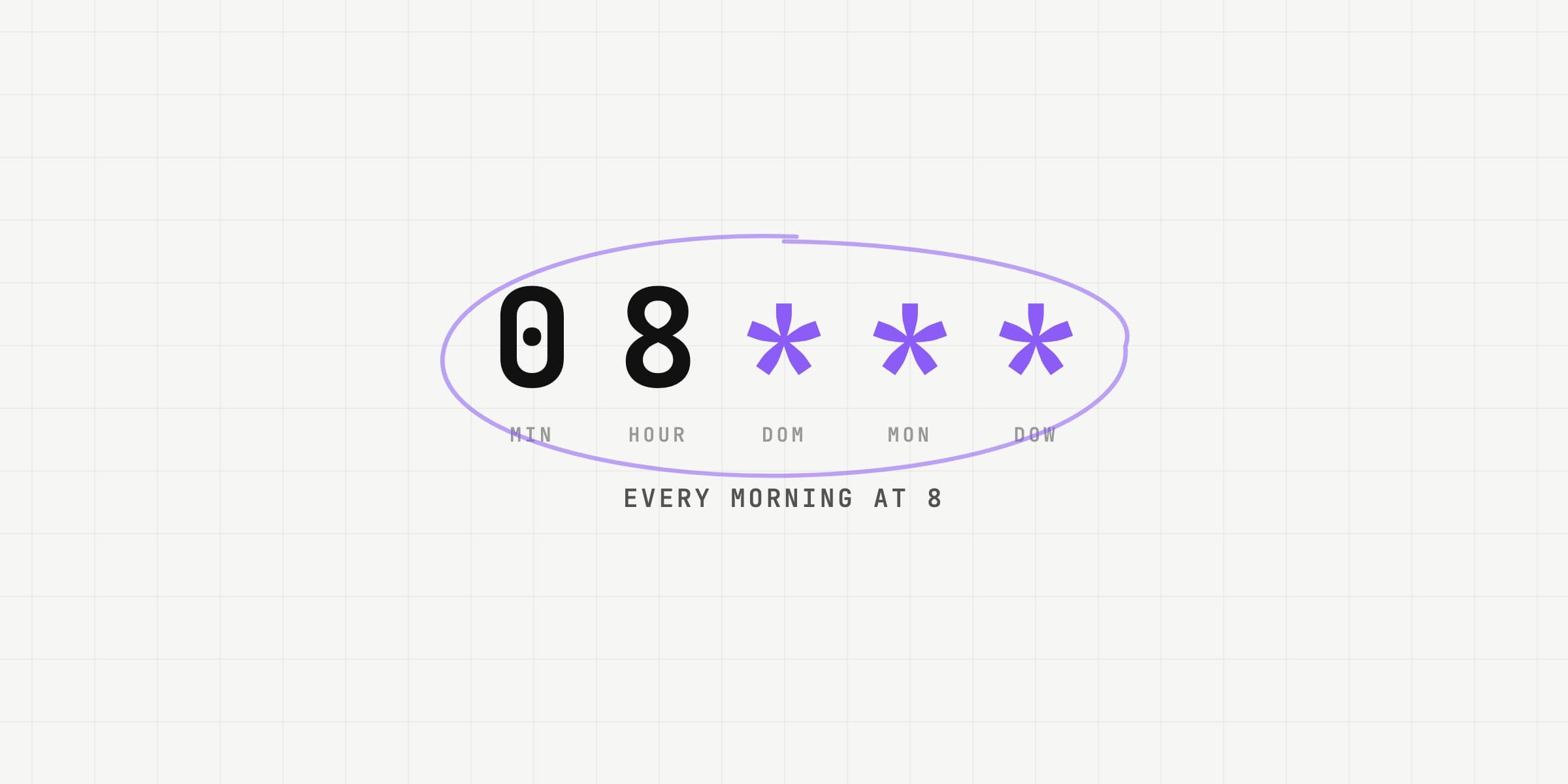
The agent is the interesting part, but the cron expression itself is still where a lot of routines quietly go wrong. Worth having the five fields cold:
Each field takes more than a single number:
* — every value. */15 — every 15th (a step): */15 * * * * is every quarter hour.1-5 — a range (Monday to Friday in the weekday field).1,15 — a list (the 1st and the 15th).@daily, @hourly, @weekly, @reboot — shorthands some schedulers accept for the common
cases.Three failure modes survive intact into the AI era:
0 8 * * * is 8am in some zone. If you don't know which, you don't know
when your routine runs. State the zone explicitly; don't let a server's
UTC default decide your "every morning" is happening at midnight local.2:30 on the spring-forward night can be skipped entirely; on the fall-back night it
can fire twice. If the run matters, keep it out of the 1am–3am window, and — again — make it
idempotent so a double-fire is harmless.0 9 13 * 5 is not "the 13th if it's a Friday." It's
"the 13th, and also every Friday." This has been surprising people since the 1970s and it
will surprise you too. Want "the 13th only when it's Friday"? You can't say it in one
expression; schedule the 13th and let the job check the weekday itself.The routine wrapper doesn't rescue you from any of this. Cron semantics are cron semantics; the agent just does something more expensive than usual when the expression is wrong.
There's a neighbouring feature worth drawing a line against, because they solve different problems. A loop re-runs a prompt on an interval inside the current session — it keeps your context and is meant for "watch this thing until it's done": babysit a deploy, poll a build, iterate on a task while you're around. A routine is a scheduled cloud run with no session and no you: it wakes up cold, does one self-contained job, and exits.
The rule of thumb: if the work needs the conversation you're in right now, it's a loop. If the work should happen whether or not you're at your machine, it's a routine. Reaching for a routine to babysit something you're actively watching gives you a cold agent fumbling for context it would have had for free in-session. Reaching for a loop to run a nightly job means it only runs on the nights you happened to leave the session open.
A cron job mailed you its stdout. A routine, left alone, is a black box that may or may not be doing its work at 3am. Before you trust one, wire up three things:
Strip away the novelty and a routine is a cron-scheduled batch job whose worker happens to be a language model. The engineering that makes it trustworthy is the same engineering that makes any unattended job trustworthy, and none of it is new:
Cron got to be simple because it never had to understand its payload. Routines hand the payload a mind, which is genuinely useful — a nightly job that can read logs and judge is worth a lot — but the price is that all the guarantees cron waved off are now yours to provide. Provide them, and a routine is a tireless teammate that shows up on schedule. Skip them, and it's a very articulate way to do the wrong thing at 8am every day.